
Arizona Traffic Court Records
Most Arizona traffic tickets land in limited-jurisdiction courts. A Justice Court takes county and precinct traffic matters. A Municipal Court handles tickets written inside a city or town. The court printed on the citation is the first clue to where its docket lives. It is that court's clerk, not a statewide driver-record office, who maintains the Arizona citation case, its hearings, and its disposition.
Civil and criminal traffic cases split from there, and the split matters. A civil infraction is admitted or contested under the civil traffic rules. A misdemeanor follows criminal procedure in the court with jurisdiction. That includes a criminal DUI charge. A felony goes the same route. An appeal from a Justice or Municipal Court goes up to Superior Court. A later appeal opens a separate appellate case. So Arizona traffic court records depend on the charge and the court. The word "traffic" alone is not enough.
Arizona Has No Complete Statewide Traffic-Docket Search
Arizona Public Access is the closest thing Arizona has to a statewide case locator. It is not a dedicated citation search. Its coverage notice currently lists 177 of 184 court sources. Some populations are partial. Some courts are excluded. A missing traffic case can mean the court does not report that case type. The case may be newer than the weekly refresh. Or only the local court's system holds it. A blank result is not proof that no citation or hearing exists.
AZCourtPay answers a different question: whether an eligible balance can be found and paid. It does not return every docket event, hearing, filing, or final court order. Local calendars are narrower still. Maricopa Superior Court's Today's Hearings page refreshes every two minutes. Yet it excludes initial appearances from that search. It does not list every judicial activity.
The official Maricopa Today's Hearings page shows local search controls. It also lists column headings for that one court. It is a calendar tool, not the citation record a Justice or Municipal Court holds.
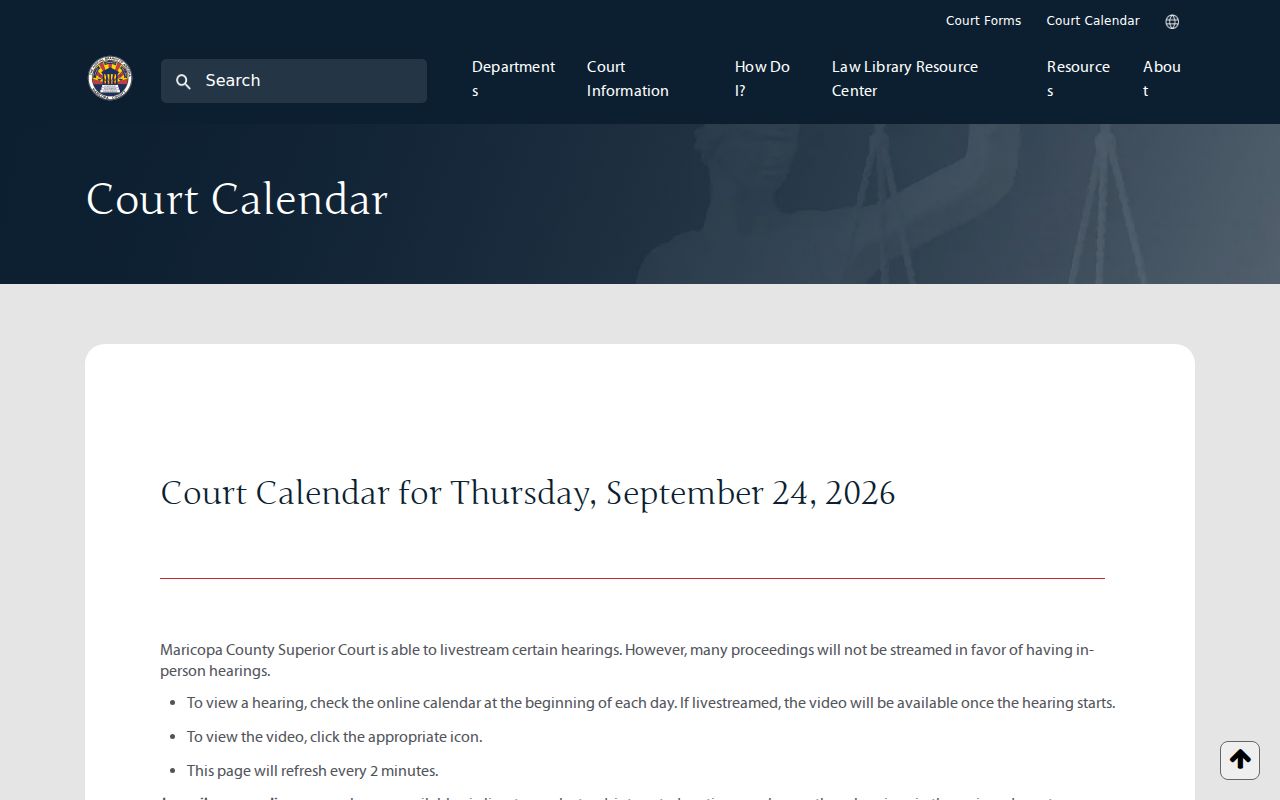
The calendar headings can point you to a published hearing row. They do not expose the full Arizona traffic docket kept by the issuing lower court.
Note: Arizona Public Access coverage counts court sources, not a guarantee that every traffic charge from each source appears online.
Arizona Citation and License-Hold Systems
Several Arizona systems touch a ticket, and each keeps a different slice of information. Public Access locates participating case information. AZCourtPay searches eligible payment obligations. TTEAP reports certain vehicle-registration renewal holds. The court itself holds the docket, while ADOT's Motor Vehicle Division keeps the driving record that courts report.
| System | What It Holds | Run By |
|---|---|---|
| Arizona Public Access | Participating court case information, including some traffic entries; partial coverage and weekly refresh. | Arizona Judicial Branch / AOC |
| Arizona AZCourtPay | Eligible Arizona balances found by notice, case, or citation number; not a complete case history. | Judiciary-linked payment service |
| Arizona TTEAP lookup | Reported Arizona failure-to-appear or failure-to-pay holds that can block vehicle registration renewal. | Arizona Judicial Branch Consolidated Collections Unit |
| Arizona Justice or Municipal Court portal | The Arizona citation case, local docket, court date, response, and available payment or document details. | Court named on the Arizona citation |
| Arizona MVD driver record | Driving record and traffic conviction information sent to the state. | Arizona Department of Transportation Motor Vehicle Division |
Know which row you are reading. An Arizona court docket, a payment result, a registration hold, and an MVD record are separate records. A portal's job and its coverage set the limits of what an Arizona search result can confirm.
AZCourtPay Searches Eligible Payments
AZCourtPay asks for an identifier before its payment-eligibility screen opens. The notice-number example is split across three boxes. A case number may look like TR123456 or a six-digit suffix. A citation number can run up to 21 characters. Match the number you choose to the ticket or court paper exactly.
| Notice Number | Three-part entry. The displayed Arizona example is 01 03724 00134; copy the notice number as printed. |
|---|---|
| Case Number | Alternative identifier, such as TR123456 or a six-digit suffix. |
| Citation Number | Alternative citation entry, up to 21 characters. |
| Continue | Opens the payment result and eligibility flow. It is not a calendar or case-history search. |
Use the Arizona AZCourtPay payment search only to check or pay an eligible balance. A result does not show every filing. Nor does it prove the court has posted your payment. If the case is missing, contact the issuing Arizona court. The same goes if no amount is offered. The same goes for an unclear due date. Keep the receipt, then verify the disposition with the court clerk.
Note: A payment lookup can identify an eligible balance, but it does not establish the full status of an Arizona traffic case.
Looking Up an Arizona Traffic Ticket
Begin an Arizona ticket lookup with the court and identifier printed on the citation. Skip the general web search. Save the notice, case, and citation numbers, and note the response date. Then use each statewide system for its stated purpose. The court that owns the case comes next.
- Read the Arizona ticket for the issuing Justice or Municipal Court, court location, citation number, and response date. A city citation belongs to the named city court even though the county directory is organized by county.
- Search Arizona Public Access if the Arizona court participates. Check the Arizona coverage roster if no result appears, and remember that case information refreshes weekly.
- Use Arizona AZCourtPay only when checking an eligible payment balance. Do not treat a payment result as the full Arizona docket or as proof of the court's final disposition.
- Open the county route in the Arizona County Directory, then follow it to the named Arizona Justice or Municipal Court. For a city ticket, use that city's court page from the county's local court information.
- Call the Arizona court clerk to confirm the deadline, current hearing date, payment posting, or copy request. Ask how to appear or contest if the Arizona ticket does not answer that question.
The Maricopa Justice Courts case search is one county's tool, not the Arizona statewide form. It offers name, business-name, and case-number routes. Name and date-of-birth fields sit in its lookup flow.
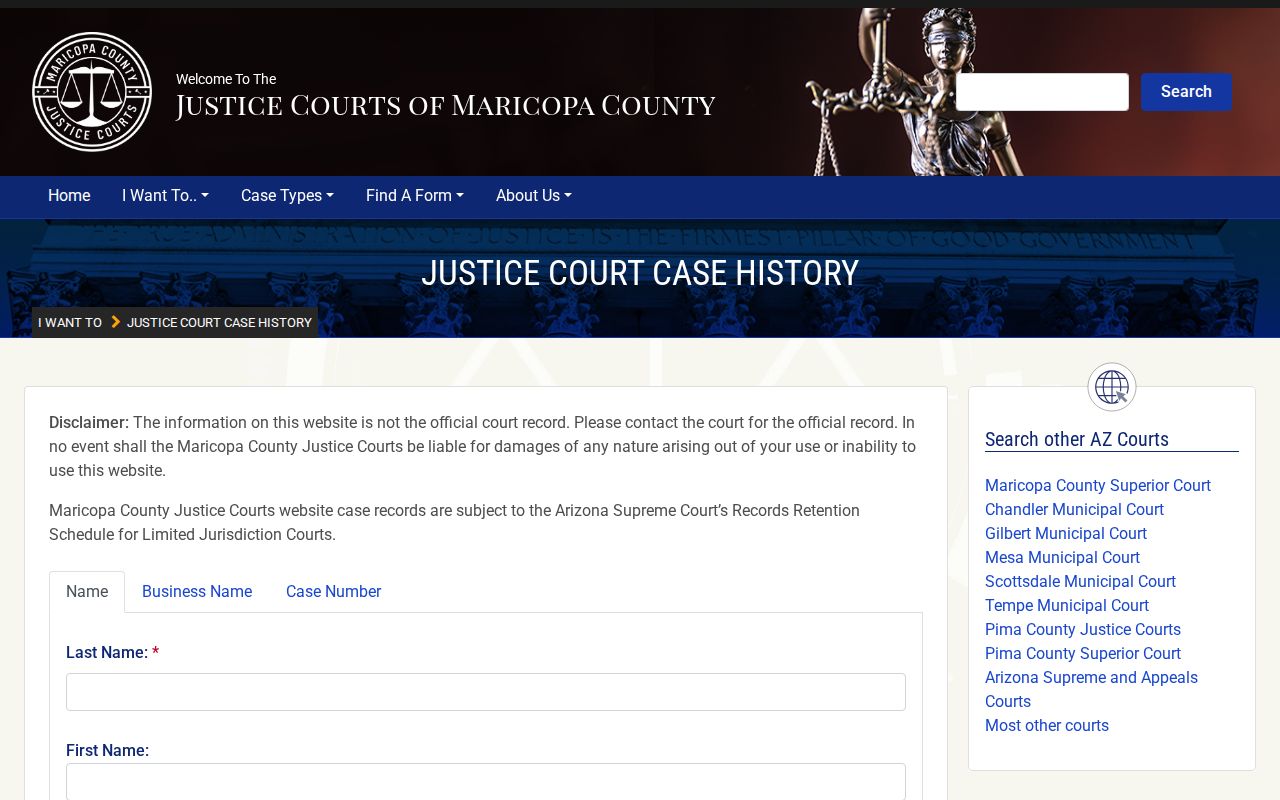
That form shows a local case lookup. It comes from one Arizona Justice Court. Another court may use a different site. It may also ask for a different set of fields. For an Arizona ticket with a hearing date, the local court calendar controls the setting. The Court Dates page explains how to confirm that calendar entry and any later reset.
TTEAP Holds Arizona Vehicle Registration
Arizona runs a program called the Traffic Ticket Enforcement Assistance Program. TTEAP places a hold on vehicle registration when certain court obligations go unresolved. A missed court date alone does not trigger it, though. Under A.R.S. §28-1631, the failure to appear must ripen into a judgment or default. That default must create a monetary court obligation before the other conditions apply. A.R.S. §28-1632 then requires two collection attempts. Only then can an eligible hold be placed on a renewal.
TTEAP also runs its own statewide lookup. To search for a reported registration hold in Arizona, enter a name and date of birth. A driver-license number is optional. Vehicle co-owners should check the search too. The hold attaches to the registration rather than the person.
| TTEAP Name | Required name for the person or vehicle co-owner associated with a reported hold. |
|---|---|
| TTEAP Date of Birth | Required date of birth for the registration-hold search. |
| TTEAP Driver License Number | Optional license-number value; the result is still a registration-hold status. |
The Arizona Judicial Branch TTEAP page explains the hold lookup. It also makes clear that TTEAP affects vehicle registration only, never a driver's license.
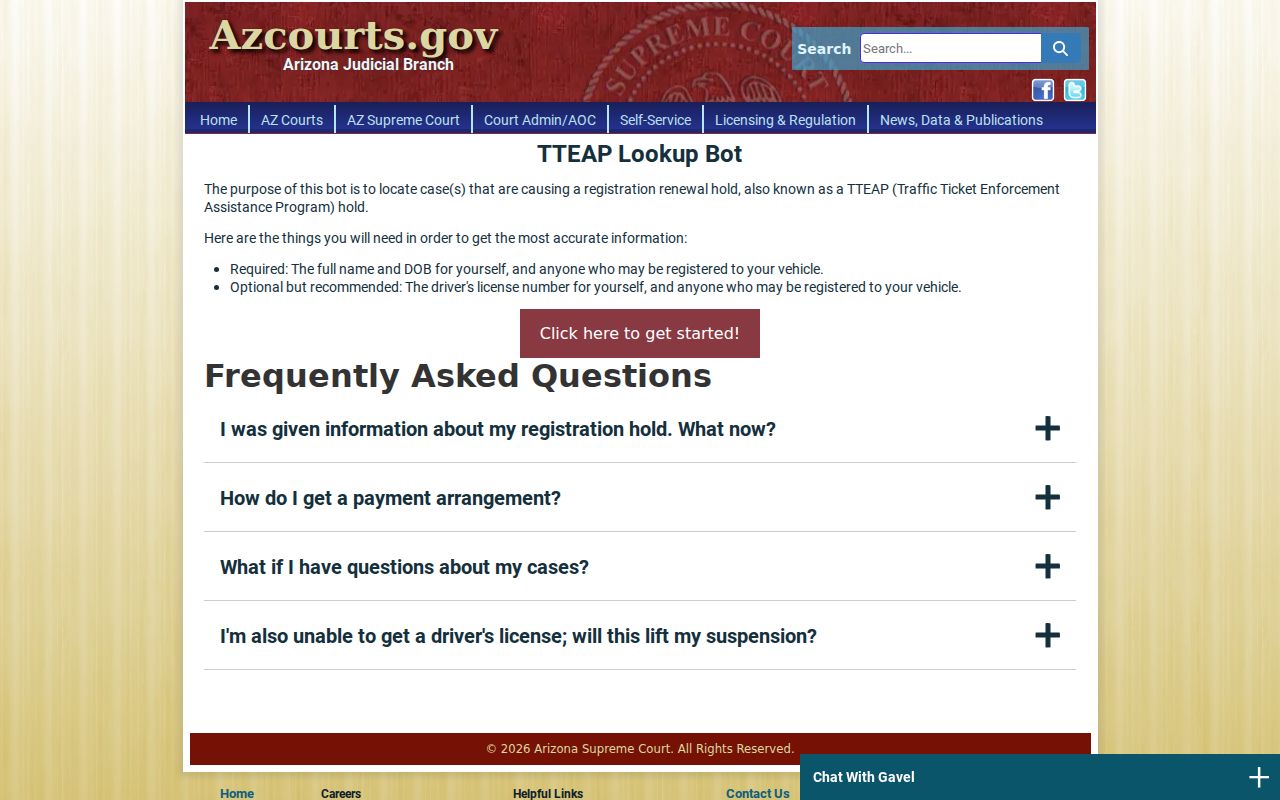
What TTEAP returns is a registration-hold status. It does not replace the case docket. The Justice Court or Municipal Court handling the ticket holds that record.
Clearing a hold takes time. The Judicial Branch's case-payment and collections FAQ states that online clearance usually appears within about one hour. That clock starts after the court enters a payment or resolution. Pay directly at the court window and the hold may linger. It can last until the next business day. If it still shows afterward, contact the reporting court or TTEAP support with proof the case was resolved. Arizona lists no separate defendant-facing TTEAP fee. The underlying court balance and local costs still come due.
Registration hold, not license status: A TTEAP hold blocks vehicle registration renewal or transfer. It does not itself suspend or block renewal of a driver's license.
Note: Arizona court payment and hold updates can reach different systems at different times, so check the status after the court records resolution.
Paying or Fighting an Arizona Ticket
An Arizona civil traffic citation offers a basic choice. Civil Traffic Rule 10 lets a driver admit responsibility or deny it. The citation itself, along with the issuing court, sets the correct path and timing. No single response deadline covers every Arizona court. An online admission or payment route may exist for eligible cases, but the court still controls the record and any hearing notice.
| Route | What Happens | Check Before Acting |
|---|---|---|
| Admit and pay an eligible Arizona civil citation | The defendant admits responsibility in person or by signed statement and tenders the Arizona civil sanction. | Follow the Arizona due date and route on the ticket or court site. Confirm the court posted the disposition. |
| Deny responsibility and contest an Arizona ticket | The Arizona court sets a hearing and notifies the defendant and citing officer; a qualifying civil sanction may be tendered while requesting a hearing under the rule. | Respond by the Arizona citation's deadline and ask the court about appearance instructions. |
| Use eligible Arizona defensive-driving diversion | After approved course completion and required charges, an eligible Arizona moving violation can be dismissed under program rules. | Check Arizona eligibility and course completion deadlines before the court date. |
| Ignore the Arizona notice or miss a required appearance | The Arizona court may enter a failure-to-appear or nonpayment event and take further steps. | Contact the issuing Arizona court promptly about the docket and any hold or obligation. |
Arizona Civil Traffic Rule 10 spells out the admit-or-deny procedure. Paying a processor is not a certified court disposition. Keep your payment proof, then check the Arizona court docket for the posted result.
Do not ignore a missed date: Contact the court named on the ticket and ask what was entered and how to respond. TTEAP can apply only when its statutory conditions are met; a missed appearance alone is not an automatic registration hold.
Defensive Driving Can Divert an Arizona Citation
Arizona's defensive-driving program can divert a qualifying civil moving violation. Not every traffic case qualifies. Eligibility turns on the statute, the citation, and the court. The program generally allows one citation in a 12-month period. The approved course must be finished at least seven days before the court date. Confirm the case and current conditions before signing up.
Finish the diversion and the cited charge can be dismissed under program rules. Enrollment alone proves nothing, since dismissal requires completion. Court and school costs vary across Arizona and change in April and October. Ask the program for current amounts first.
The Arizona Supreme Court defensive-driving cost page offers a court-by-court cost selector. It shows how local charges differ. The ticketing court still decides eligibility and records the final docket disposition.
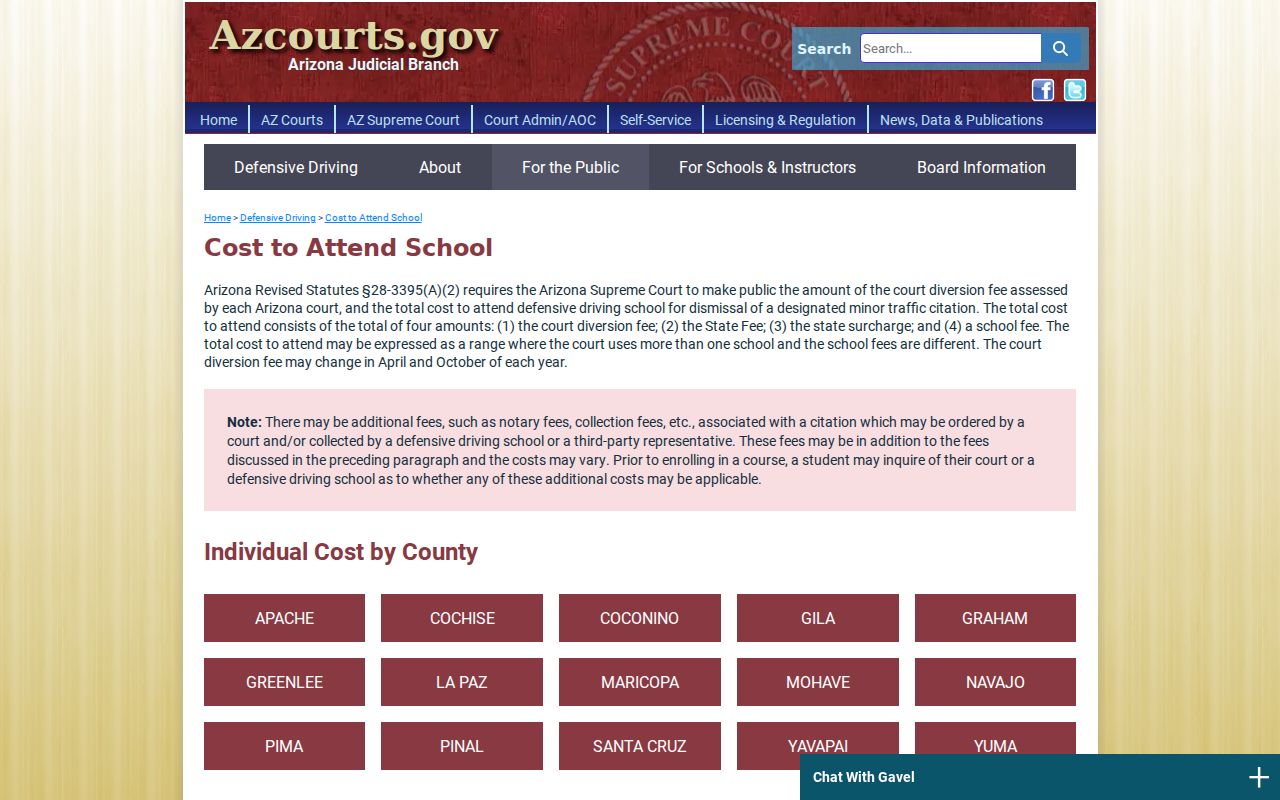
That selector compares costs across Arizona courts and schools. It says nothing about whether a given citation qualifies for diversion.
Arizona's program rules sit in A.R.S. §§28-3392 through 28-3397, plus the Supreme Court's defensive-driving program information and program FAQ. A completed diversion can turn the court entry to dismissed. The court itself must record that result on the docket.
Arizona Court Record vs Driver Record
Two different records follow an Arizona traffic case. The Justice Court or Municipal Court clerk keeps the docket: citation complaint, plea, hearing, judgment, fine, and disposition. The Motor Vehicle Division under the Arizona Department of Transportation keeps the driving record. Under state law, MVD receives conviction information from Arizona courts. Each office answers for its own file.
| Record | Custodian | What It Shows | Where to Resolve a Problem |
|---|---|---|---|
| Arizona court traffic case | The Arizona Justice, Municipal, or Superior Court clerk that holds the case. | Arizona citation, filings, plea, hearings, disposition, fine, and appeal entries. | Search or request the Arizona record from the court named on the ticket. |
| Arizona MVD driving record | Arizona Department of Transportation Motor Vehicle Division. | Arizona driving history and traffic conviction information transmitted by a court. | Use ADOT/MVD channels for the Arizona driver record; contact the court if its transmission or disposition is in question. |
A case can end in court before state systems catch up. A.R.S. §28-1559 sets the timing for abstracts. It generally requires adult traffic abstracts within 10 days. Juvenile traffic dispositions are due within 30 days. The Arizona court docket may show a result the MVD record lacks. Confirm the court transmitted it. Then contact whichever office holds that record.
Note: Arizona's court docket and MVD file answer different questions; neither should be treated as a substitute for the other.
Arizona Photo Notices and Court Service
A camera notice in Arizona may not be a court case yet. The first mailed photo-enforcement notice can be a civil notice only. Under A.R.S. §28-1602, someone who receives just that initial notice need not respond right away. Formal service must be completed as the statute requires. A camera image or mailed letter is not a docket entry you can search.
Once served and filed, the citation goes to court. It lands in the issuing city's Municipal Court or the proper Justice Court. From there the court's ordinary response process applies. Keep the notice handy so the court, citation number, and service status stay clear. Go to that court for the case date, payment, contest instructions, or record request. Signage and related standards appear in A.R.S. §28-1204.
Read the Arizona photo-enforcement service statute and Arizona photo-enforcement standards for the notice and service rules. If the court has filed the citation, follow its docket. Follow the response deadline too, rather than the notice alone.
Note: The service status can change which response duties apply, so preserve the Arizona notice and confirm filing with the court it names.