
Searching Arizona Court Dockets
A good Arizona docket search starts with whatever paper you have: a citation, a court notice, or the case number itself. Arizona offers a free Public Access locator. It pulls case information from participating courts across the state. It won't return every case type, though, and it never holds the clerk's complete record. Treat a result as a pointer, not the file. Use it to identify the local Arizona court. Then go to that court's own records system or call its clerk for the full case history.
Court level matters here. A Superior Court criminal or civil case follows a different online path than a city traffic citation. So does a Justice Court small-claims filing. Keeping the levels straight prevents a common mistake: treating the statewide index as the official docket. It isn't.
- Read the citation, order, or prior filing and copy the Arizona court, county, case number, and case type exactly.
- Try Arizona Public Access with the party name or case number when the Arizona court and case type are included.
- Check Arizona's statewide coverage list if no result appears or the listed court has partial coverage.
- For eligible Arizona Superior Court civil or criminal documents, search eAccess; for other matters, open the local court's own case search.
- Compare the newest event and hearing setting, then ask the Arizona clerk for an official record or certified copy when needed.
Searching by case number beats searching by name for precision. Keep the punctuation and leading zeroes exactly as they appear. If the statewide service returns nothing, open the Arizona County Directory and go to the county court page for that filing.
Why Arizona Cases Miss Statewide Search
Arizona's portal gathers data from 177 of 184 court sources statewide. That sounds complete, but it isn't. Some courts show up only for selected case populations, and the gaps are real. Appellate courts are missing. So are portions of Justice and Municipal Court data and certain Superior Court case types. A local-ordinance charge may be left out on purpose. So may a probate or mental-health matter, a protection-order case, a sealed record, or juvenile delinquency detail.
A blank result screen does not mean the case was never filed. A brand-new filing may still be waiting on the portal's weekly update. The court may not participate for that case type. Or an Arizona confidentiality rule may block remote access to the court record. Check the official unavailable and partial-courts list before picking up the phone. The Arizona Judicial Branch coverage list names the court populations that are unavailable. It also names the ones only partly represented.
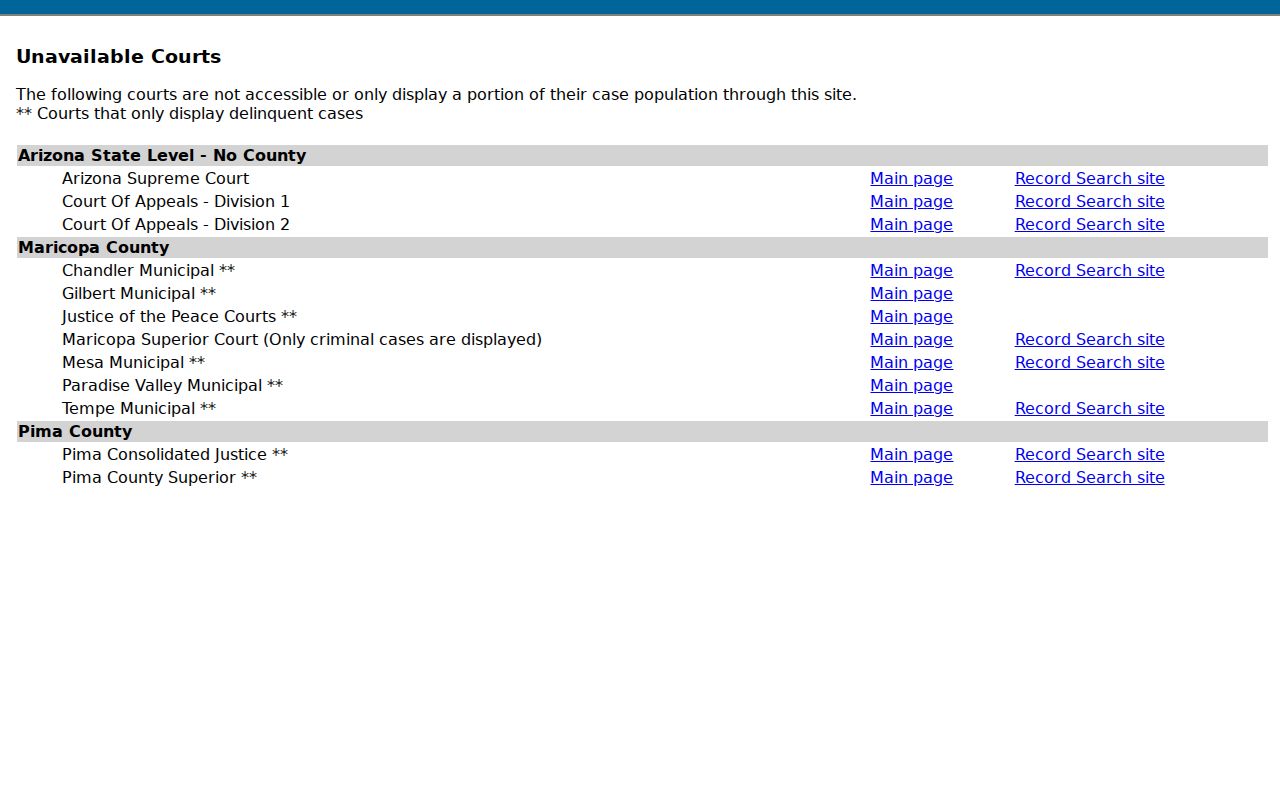
Read that list as a coverage note, not a list of closed courts. A local Arizona clerk may still hold a public case record that the statewide docket search never displays.
Inside the Arizona Statewide Case Search
Public Access to Court Case Information is the Arizona Judicial Branch's free statewide case lookup. One hurdle comes first. Retype randomly generated verification words and press Submit before the search form opens. The page explains that the CAPTCHA limits high-volume use. The details sit behind that gate. Because of that, the static page can't confirm whether a full court or county dropdown list exists on the other side. The portal's own validator does show what a name search requires. It needs a last name or business name. It also offers CV-200812345 as a case-number example.
Updates land each Friday and cover filings through the previous Wednesday. Remember what this portal is not. It is not the clerk's official record. It also carries no general collection of document images. A separate Minute Entry Search covers selected Superior Court criminal entries recorded from January 1, 2010. It has its own CAPTCHA and its own coverage limits.
| Arizona Search Control | What Arizona's Page Confirms | What It Does Not Confirm |
|---|---|---|
| Verification words | Text entry is required before a search; a Submit button advances | It does not identify case coverage |
| Name search | Last name or business name is needed for this route | The gated page does not reveal every field or dropdown |
| Case number | Validator example: CV-200812345 | Local punctuation and codes can differ |
| Minute Entry Search | Separate route for selected criminal minute entries | It is not a full document archive |
The Arizona Public Access lookup begins with the required verification step.
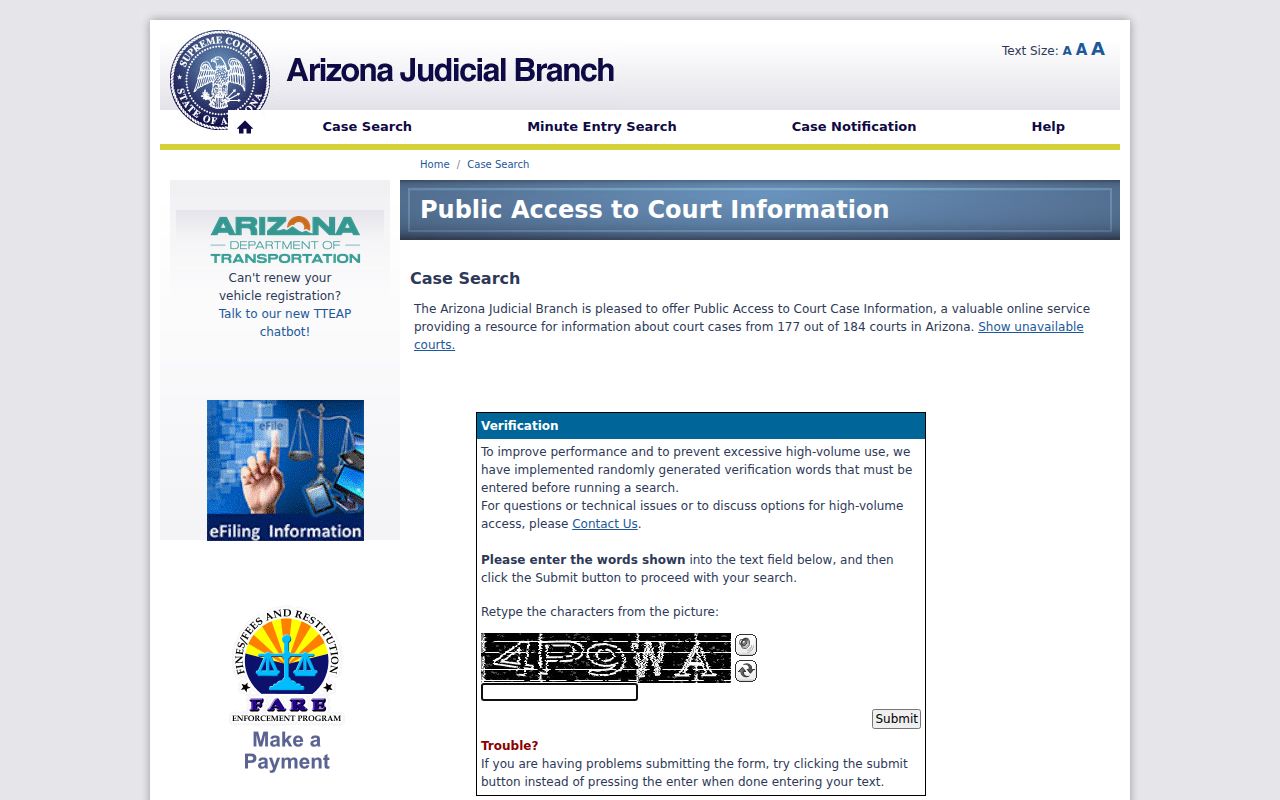
Once you're past the Arizona gate, stick to the fields the live form actually offers. County filters you've seen in another court system may not exist statewide.
eAccess Adds Arizona Superior Court Documents
eAccess and Public Access do different jobs. Where eAccess shines is documents. It offers 24-hour access to eligible Arizona Superior Court civil and criminal case information. It also covers document images filed on or after July 1, 2010. Pima County criminal files start later, at July 1, 2015. Probate, juvenile, and family or domestic-relations cases are excluded. So are sealed and otherwise restricted documents.
Registration is required before you can use the service. Pricing works in tiers. The first page of any document is a free preview. A full document costs $10 per purchase or comes with a recurring monthly plan. An electronically certified copy runs $45 on a pay-as-you-go account or $35 with a recurring subscription. Act quickly once you buy. A purchased document stays available for 24 hours, so download or print it before the window closes. Some agencies will still insist on a paper copy with a raised seal. Only the county Clerk of the Superior Court can provide that.
Use the Arizona eAccess service for any covered image. For a case outside its dates or case types, the Clerk of the Superior Court remains the record holder.
Which Arizona Courts Keep Dockets
Arizona has no single clerk and no single docket database for every kind of case. The Arizona Supreme Court and the Court of Appeals keep their own appellate records. Those sit separate from everything below them. Superior Court handles general-jurisdiction matters. Justice and Municipal Courts take the limited cases assigned to them. To guess which Arizona court owns a file, read the case caption or citation. It's the best clue you have.
| Court | Docket Covers | Where to Search |
|---|---|---|
| Arizona Superior Court | Felonies, major civil cases, family, probate, juvenile, and some appeals from lower courts | Public Access for participating case data, eAccess for eligible civil/criminal documents, or the county clerk |
| Arizona Justice Court | Traffic, misdemeanors, small claims, evictions, and preliminary felony proceedings | That precinct court's own case search or clerk |
| Arizona Municipal Court | City or town ordinance matters, traffic, and assigned misdemeanors | The city or town court that received the citation |
| Arizona appellate courts | Appeals, petitions, appellate events, opinions, and argument settings | The applicable appellate case portal or appellate clerk |
For a map of how each level fits together, the Arizona Court System overview lays out the connections, though the records at each level stay separate.
Arizona Superior Court Docket Branches
Arizona runs a single Superior Court. It has a branch in every one of its 15 counties. Each county elects its own Arizona clerk. That office keeps the case files for criminal, civil, family, probate, and juvenile matters alike. Some states divide this work between a criminal clerk and a civil clerk. Arizona does not. One Clerk of the Superior Court holds both categories of court records.
Branch geography still shapes any docket search. A party name may surface the case. But the county points you to the right clerk's office for a copy, a correction, or a certification. Justice Court and Municipal Court filings never migrate into the Superior Court file. That stays true just because those courts sit in the same county. And when an appeal is filed, the original trial docket stays put at its court. The appellate level opens a new number and builds its own record.
What an Arizona Court Docket Shows
Think of an Arizona court docket as a running account. It records everything that happens in a case. A statewide result gives you case identity plus selected activity. The local docket often goes further, listing filings, minute entries, hearings, and judicial orders. One caution applies. An event line is not always the same as the filed document behind it. When exact wording or a specific ruling matters, get the underlying document from the court or the clerk.
| Case Number | Match the full number and local format; eAccess examples include CR202301234 and CV case-type filters. |
|---|---|
| Case Caption | The short case title and party roles; protected details may be omitted. |
| Docket Events | Dated filings, court actions, minute entries, and status changes. |
| Hearing Setting | Date, time, event type, and sometimes courtroom or judicial officer. |
| Disposition | The outcome or current status, whose exact code can vary by local system. |
Arizona publishes no complete statewide list of docket-event abbreviations. Keep the case number's prefix and punctuation intact, and ask the Arizona clerk to decode any unfamiliar local event term.
Arizona Minute Entries and Court Dockets
A minute entry is how an Arizona court writes down an event or official act. Arizona Supreme Court Rule 125 is clear. It is not a word-for-word transcript of what was said at a hearing. Instead, the entry may summarize an appearance, record an order, or note the next step. A court reporter's transcript is a different product entirely. It has its own request process and its own price.
Several common docket terms help you tell a new setting apart from the event that came before it:
- Minute entry
- A written summary of court events and official acts, not a word-for-word transcript.
- Setting
- A scheduled court event, such as an arraignment, motion hearing, or trial date.
- Continuance or reset
- A change that moves a scheduled proceeding to a later date or another calendar slot.
- Disposition
- The outcome or status recorded for a case or charge.
A later setting never erases the earlier docket event. Read the newest order or minute entry. Then confirm the next date with the Arizona court if the calendar or statewide index looks stale.
Arizona Appeals Receive a Separate Docket
A notice of appeal will show up in the trial-court docket. The appeal itself gets its own case number. It also gets its own filing history. Most Arizona Superior Court appeals land at the Court of Appeals, in Division One or Division Two. The Arizona Supreme Court takes specified direct matters plus petitions for review. Its active-case information, the two divisions' portals, and the trial docket are each separate search routes.
Federal cases sit outside all of this. The U.S. District Court for the District of Arizona keeps federal trial dockets, and its appeals go to the Ninth Circuit. Neither court appears in Arizona's statewide case search.
The District of Arizona federal court site lists the court's federal resources and locations.
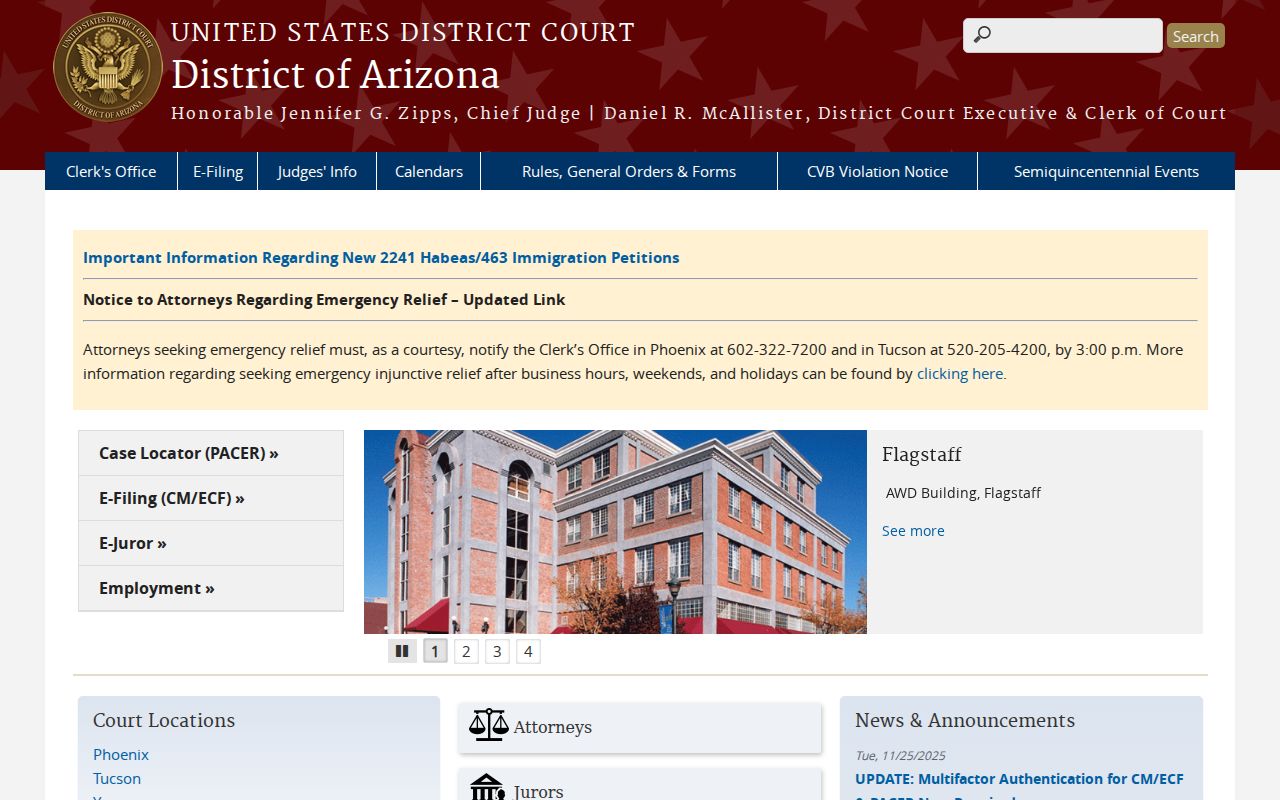
Federal dockets live in the federal court system, usually PACER, not the Arizona Judicial Branch portal that handles state cases.
For costs, the PACER fee page spells out the per-page federal charge and the current waiver rules.
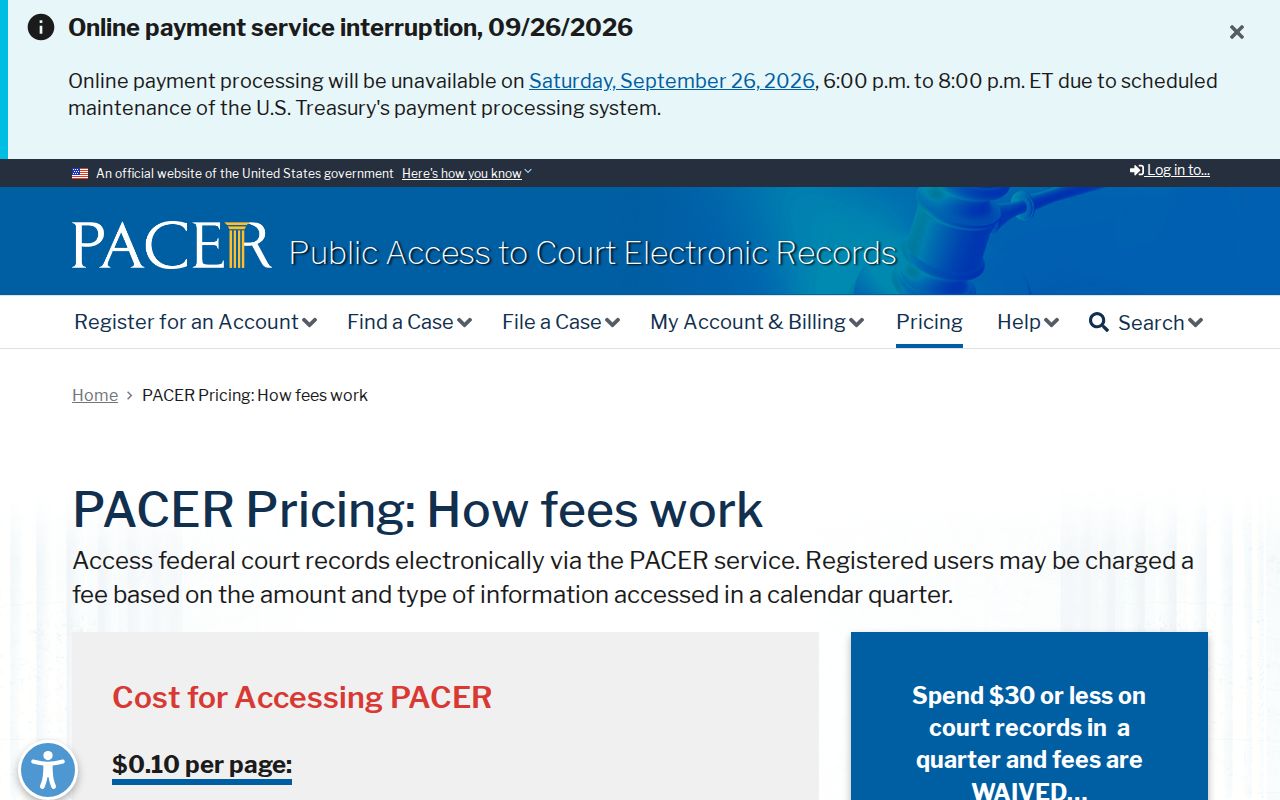
That federal portal runs on a different court system and billing schedule. Treat it as its own thing, not a second state case index.
Arizona Public Access to Dockets
Arizona judicial case records are open by default. A law, rule, or court order can say otherwise. The main case-record rule is Arizona Supreme Court Rule 123. The Arizona Public Records Law, A.R.S. §§ 39-121 et seq., provides a general inspection right, but a court case request still goes to the judicial custodian under Rule 123. Remote electronic access carries separate terms under ACJA §1-604.
Arizona access rules:
Arizona Supreme Court Rule 123 governs access to judicial records and recognizes legal, rule-based, and court-ordered restrictions.
A.R.S. §39-121 covers inspection of public records held by Arizona public bodies; it is not a substitute for a court-record request.
A.R.S. §13-911 allows eligible criminal case records to be sealed by court order after statutory conditions are met.
A.R.S. §8-208 limits disclosure of juvenile court records.
| Arizona Superior Court Service | Statewide Base | Request Route |
|---|---|---|
| Copy of a record | $0.50 per page | Ask the Clerk of the Superior Court about local access and added charges. |
| Certificate of correctness | $35 | Request it from the clerk who holds the case file. |
| Exemplification (two seals) | $70 | Specialized authentication product. |
| Authentication (three seals) | $105 | Confirm the required product with the receiving agency. |
| Document research | $35 per year and source searched | Ask the clerk which years and sources need to be searched. |
| Postage and handling | $8 | May apply when copies are mailed. |
Effective December 28, 2024, the Arizona Superior Court copy-fee schedule lists the statewide base amounts.
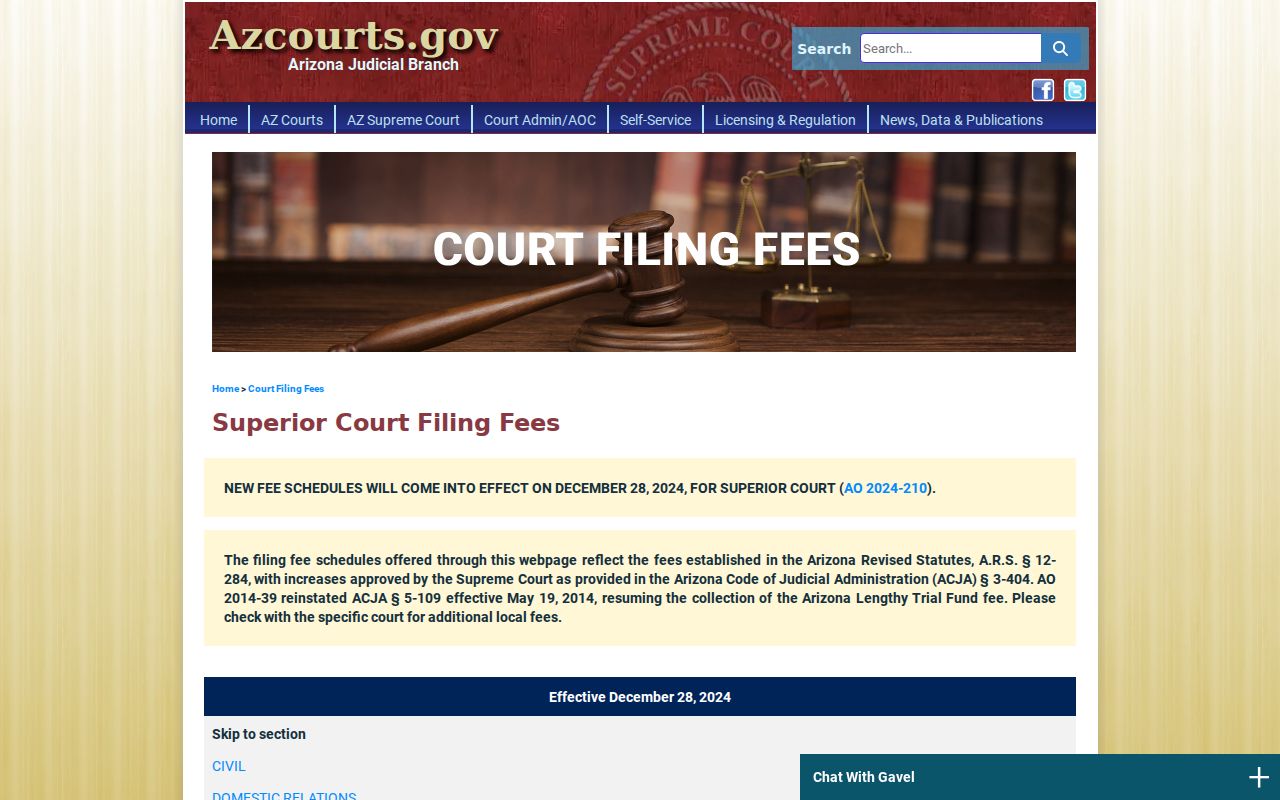
Need a case file? Ask the clerk who holds it for a plain or certified copy. An AOC administrative-record form is not a county case-file request.
Arizona Court Access Changes in 2025 and 2026
Arizona court access rules shift on their own schedule. A docket search that worked last year may behave differently today. One example matters right now. An emergency amendment to Arizona Supreme Court Rule 123 took effect on December 1, 2025. It limits what remote searchers can see about an arrest warrant before charges are filed. The limit holds until proof of service is filed, the warrant expires, or a judge quashes it. Only remote access to Arizona case information is affected. Court records still exist. Access inside a court facility may not match what the online portal shows.
More change is coming. On August 27, 2026, the Arizona Supreme Court adopted a permanent version of the amendment. It takes effect January 1, 2027. Until that date, the emergency amendment remains the operative rule. Do not confuse the adoption date with the effective date. Suppose a remote Arizona docket search returns nothing. The reason could be this rule, a routine case-type exclusion, or a gap in local coverage.
The Arizona Supreme Court adoption order states the permanent effective date.
Separately, the Arizona Judicial Branch's 2026-28 information-technology plan schedules analysis and design work to replace the existing Public Access portal. The current Arizona portal stays the statewide search entry point until a replacement is announced.
Arizona FY2025 Court Docket Workload
Arizona courts handled heavy traffic in FY2025. Filings across the appellate, Superior, Justice, and Municipal levels reached 1,796,707, which the Arizona annual report calls a 2.5% increase over FY2024. The average is 7,187 filings per working day. That figure counts court filings. It does not count distinct people or criminal cases. Civil, criminal, family, traffic, small-claims, and other work all sit inside the total. The FY2025 Annual Report from the Arizona Judicial Branch publishes the statewide measure and its year.
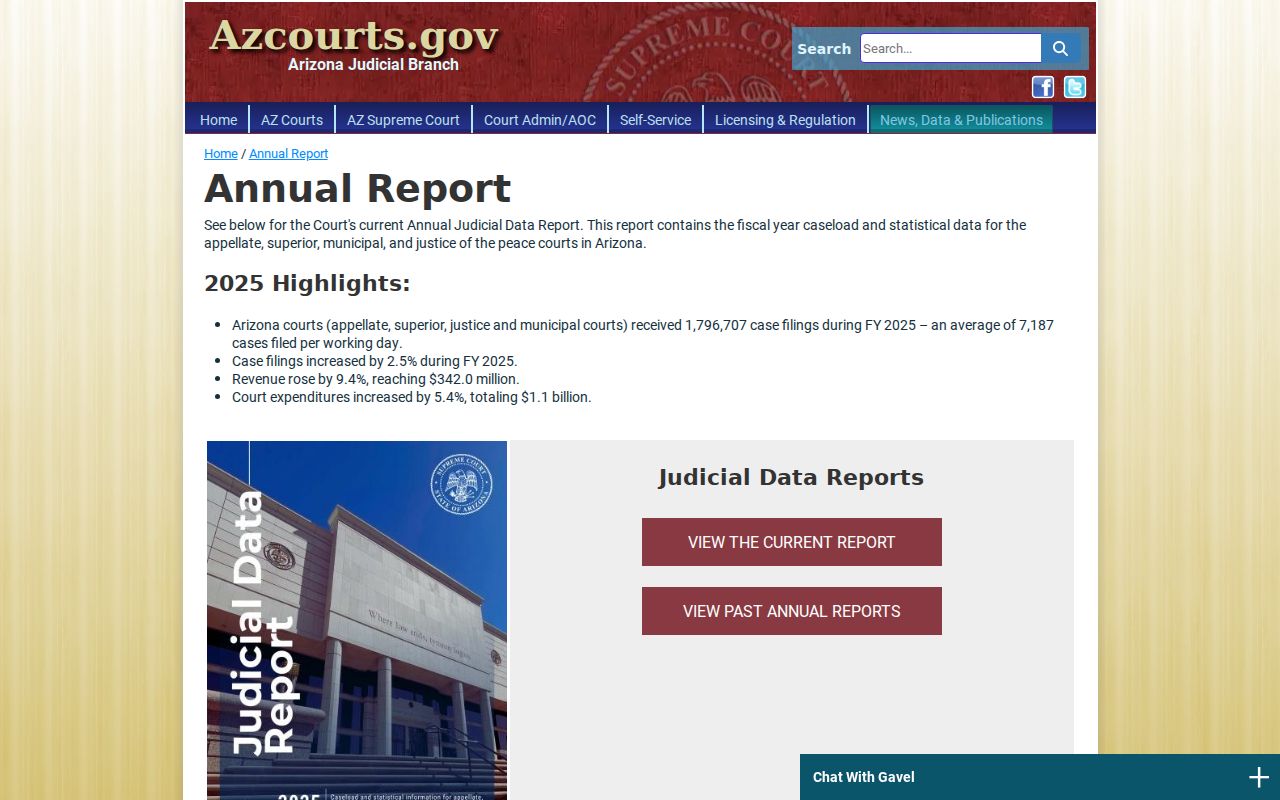
Treat that statewide sum carefully. For a particular Arizona court level or case type, the annual report's detailed data tables are the better tool. One lump docket population hides those differences. The staffing picture is just as easy to misread. The Arizona organization chart lists 185 Superior Court judges, about 109 full-time commissioners, 80 Justice Court precincts, and 142 full- or part-time Municipal Court judges. Those position totals describe court staffing, not the number of separate public search databases.
Arizona Specialty Court Dockets
Arizona runs problem-solving and specialty courts. They serve needs such as substance use, behavioral health, veterans' services, and treatment-linked supervision. They are not an extra statewide trial-court level. Each program sits inside a local Arizona court, so the docket stays with the court that accepted the case, while eligibility and program details vary by location. The Judicial Branch's specialty-court directory groups the program types and names local examples across Arizona.
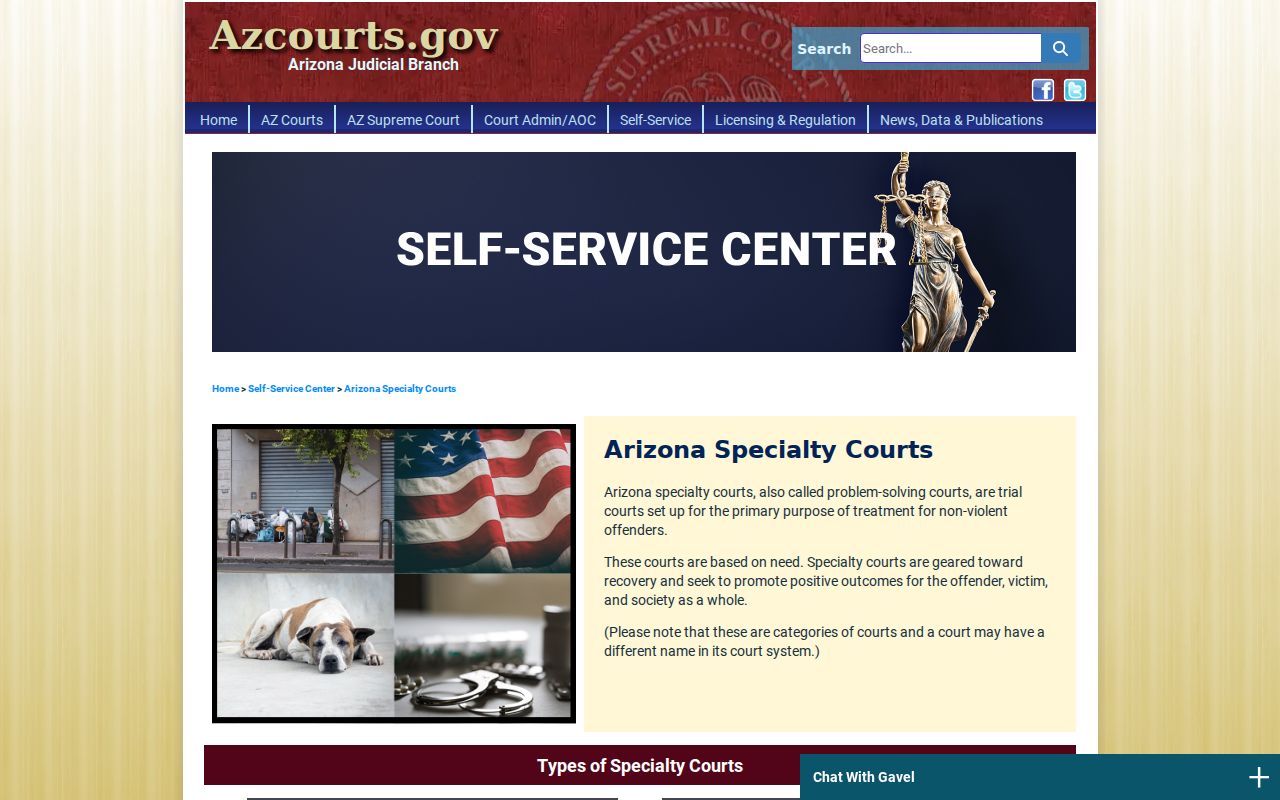
Watch for labels when tracking a specialty matter. A program name may never appear in the statewide Arizona case locator, so search the underlying court and county for a hearing or order.
Court Dockets by County in Arizona
The full docket sheet lives at the court level. That means an Arizona case lookup usually starts with knowing the county where the case was filed. The biggest population centers show how the route changes from place to place: county Superior Court systems run their own search and clerk processes, and Justice or Municipal Court records may sit somewhere else again. Each featured link opens that county's court-docket hub.
Maricopa County
Phoenix · largest county population and distinct Superior civil and criminal searches
Pima County
Tucson · second-largest population and later Superior criminal eAccess cutoff
Pinal County
Florence · a growing county with separate Superior and Justice Court records
Yavapai County
Prescott · several Justice Court precincts and a county Superior Court branch
Mohave County
Kingman · multiple court locations with distinct local dockets
Yuma County
Yuma · county court records and a local Justice Court filing route
Open the full directory of all 15 Arizona counties to reach the court docket hub for any county.